Raising Hell Part 2
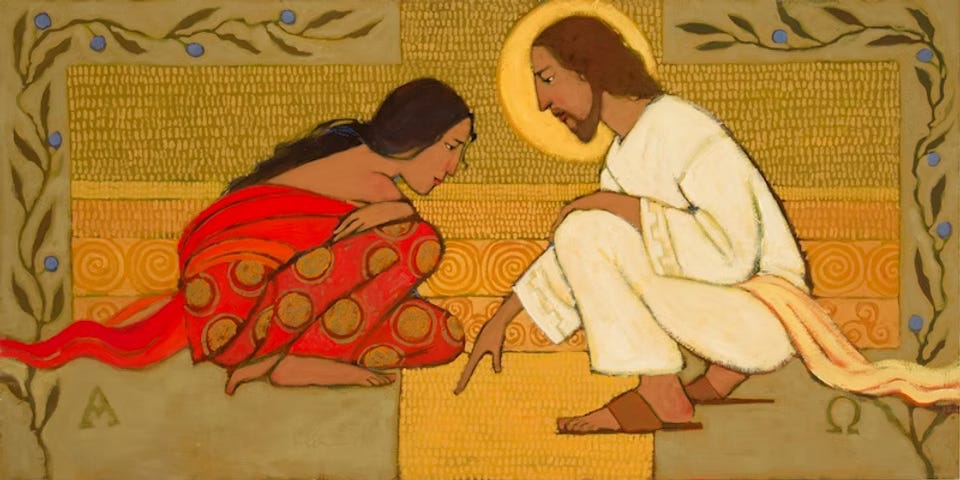
Who would trace a finger through the dust?

In Part 1 of this post, which can be found here, I shared my attempts to compartmentalize the doctrine of eternal conscious torment (ECT). As I grew older, the process became easier. My high school youth group was too focused on the pre-message games that bordered on humiliation ritual, and transitioning out of that to talking about being burned alive forever would really dampen the mood. By the time I went to bible college, I was just glad I didn’t enroll in the class that had Hell Is Real (But I Hate to Admit It) as its required reading. When the church that Lindsey and I attended for the first several years of our marriage would occasionally mention hell, it was easy enough to check out for that specific sermon.
Sure, every now and then, the thought of hell would float into my mind. And the eternity pit would grow in my stomach, but I learned to place that thought on a little imaginary boat and watch it float away. What I have come to believe is that the pit in my stomach was my conscience screaming out to me: this is not right. But I had learned ways to manage, and I was comfortable enough with that. I think I would have stayed in that spot if I hadn’t received a text one day from a good friend from college, “Do you still enjoy reading theology books?”
This was a gracious text because in college, I NEVER read the theology books we were supposed to read, but my friend had unknowingly caught me around the beginning of my remodeling journey, so I said yes.
His recommendation was That All Shall Be Saved: Heaven, Hell, and Universal Punishment by David Bentley Hart. My friend didn’t know it, but by recommending this book, he was giving me the push I needed to pull my theology of hell out of the drawer I had stuffed it in and look at it fully in the light.
Before we get to That All Shall Be Saved—which has become one of the go-to works for people arguing universal salvation—I want to look back at some work that came before it.
Drawing party lines
Many evangelicals will remember in 2011 when Rob Bell released his book, Love Wins. Before its release, Rob Bell was the prototypical evangelical superstar of the early 2000’s. He wore jeans and tennis shoes on stage. He even had a cool whiteboard! At its peak, his church, Mars Hill Bible Church, had well over 10,000 members. Bell was a successful author, public speaker, and Christian thought leader.
That all dramatically changed when he released Love Wins. In the book, Bell suggests the possibility of universal salvation. I have read the book, and there are many valid critiques of Bell’s arguments. Honestly, I think the book is a pretty messy attempt to understand what the Bible has to say about eschatology.
But it made an impact, stirring up quite a controversy in Christian circles. Even before the release of the book, when there was only a teaser video to hint at its content, the evangelical brass was ready to lay down their judgment. In these circles, there is sometimes talk about levels of doctrine. You’ll often hear these referred to as orders:
First-Order Issue: Beliefs that, if rejected, are synonymous with rejecting Christianity itself. Example: Jesus brings salvation
Second-Order Issue: Beliefs that Christians have license to disagree on, but will create barriers to communal fellowship. Example: Continuation vs. Cessation1
Third-Order Issue: Beliefs that are essentially a matter of opinion and should create no major barriers to communal fellowship. Example: Consuming alcohol
Flirting with the idea of universal salvation wasn’t a cute matter of opinion, a third-order issue. Bell had crossed the line. Almost three full weeks before the book was released, John Piper—an extremely influential theologian and founder of the ministry Desiring God—posted the following to Twitter:

In just three words, Piper laid down a verdict and sent a clear message: Rob Bell is out of the club. ECT was a first-order issue. A line had been drawn in the sand.
Jesus’ lines in the sand
Speaking of lines in the sand… Let’s take a look at a different instance of correction among religious leaders.
In John 8, we find Jesus ready to lock in for a morning of teaching in the temple, when the scribes and the Pharisees throw a woman who had been caught in adultery before him. According to the law of Moses, she should have been stoned for this, and they wanted to see what Jesus would do. They, of course, don’t really care about his verdict or the woman. She’s just an object in their game.
Jesus doesn’t take the bait. He is not afraid of the scenario they’ve thrown at him. He isn’t bound by tradition. He simply begins drawing his own lines in the sand. What is he writing? Who knows. There are several theories, but none of them holds any more water than the others. I prefer to think of it as a moment of stillness. A silent protest where Jesus communicates to the scribes and the Pharisees that he doesn’t answer to them and he doesn’t play by their rules.
Then he looks up, says to them, “Let anyone among you who is without sin be the first to throw a stone at her,” and continues to draw in the sand. One by one, the religious leaders drop their stones and begin to walk away. When there’s no one left except for Jesus and the woman, he finishes drawing in the sand, straightens up, and says, “Woman, where are they? Has no one condemned you?”
She said, “No one, sir.”
And Jesus said, “Neither do I condemn you. Go your way, and from now on do not sin again.”
Jesus doesn’t ask her to say a prayer. He doesn’t ask for a profession of faith. He doesn’t tell her it’s time to be baptised.
He simply tells her that he does not condemn her. Not because of anything she did. Because he wanted to. And because he could.
Who is God?
This brings me back to That All Shall Be Saved. The book is essentially divided into four meditations. I was most impacted by the first, which asks us simply: Who is God?
A common refrain is that God is love. I’ve heard that sentiment a thousand times. Megachurches love printing it on their t-shirts. But what does that functionally mean? Hart would argue—and I would agree—that permitting unending torture is in direct opposition to something a loving being would do.
Let’s put it in practical terms. I have two daughters whom I love as much as I am capable of loving anyone. If an ETC view of hell were real, even the thought of them going there—where a trillion times a trillion years would only be the very beginning of their suffering—would fill me with dread and sorrow. I cannot imagine an existence where I could do anything but suffer under the weight of the knowledge of their own suffering.
For those who believe in ECT (infernalists, as Hart somewhat pejoratively titles them), if God is the very definition of love, then him allowing and being comfortable with the suffering must be loving. So if I were in heaven lamenting the suffering of my children, I would be, by definition, LESS LOVING2 than God.
The classic counter-argument is that God’s ways are above our own. If that is the case—if we can’t even use similar terms when we speak of humans and God—then all talk of God is essentially meaningless. Which, of course, is ridiculous. That would mean every word of the Bible, every early church father, every keystroke in this post, would be useless.
When Jesus was confronted by the scribes and the Pharisees, he made it clear that he didn’t play by our human rules. But his rules weren’t completely incongruent with or crueler than our own. He didn’t punish the woman in a new way that was worse than stoning in order to somehow glorify himself. He removed all condemnation simply because he had the authority and ability to do so.
Another counter-argument is that God isn’t just love. He is the perfect balance of love and justice. So the eternal fires of hell have to exist to perfectly balance the love of God and the justice of God. Hart would argue that this is also ridiculous because an eternal punishment for a finite crime has no correlation to justice in the way that we understand it.
We are made in the image of God. I believe this encompasses many things, including our consciences. There’s a reason why I wouldn’t wish that on my worst enemy is a sentiment universally understood. There are some times where the punishment just doesn’t fit the crime. Our consciences are evidence of the divine in us, and if the idea of eternal torment causes uneasiness in our conscience, we should investigate it, not stuff it down because the Bible says so.
What does the Bible actually say?
The second meditation in That All Shall Be Saved centers around judgment and what the Bible has to say about it.
The two and a half people that are still reading at this point (hi Will, Reed, and maybe Alyssa 👋) will not be surprised to hear that I’m no biblical scholar, so I will be pulling from a couple resources in this section to help frame things.
So what does the Bible have to say about hell? If that kind of thing is interesting to you, this video from Dan McClellan explains it much better than I am able to. Whatever you think about Dan (I have my own issues with him, although I met him briefly once and he was incredibly generous), this is a very helpful resource.
The main takeaway from the video is that the Bible offers no one stance on what happens when we die. Like many things in the Bible, we are tasked with wrestling with it and—through collaboration with the holy spirit—trying to come to an understanding of what it is saying.
There are many places where the Bible seems to affirm some idea of eternal punishment for the unrighteous. One of the clearest examples of this comes from the Gospel of Matthew:
Then they also will answer, ‘Lord, when was it that we saw you hungry or thirsty or a stranger or naked or sick or in prison and did not take care of you?’ Then he will answer them, ‘Truly I tell you, just as you did not do it to one of the least of these, you did not do it to me.’ And these will go away into eternal punishment but the righteous into eternal life.”
Matthew 25:44-46
Seems pretty cut-and-dry, right? The righteous will have eternal life, and the wicked will be eternally punished. But, like many things in the Bible, this is not as clear as we want to make it. The Greek word Aionios (αἰώνιος) is what is being translated as ‘eternal’ here. I famously failed Greek my freshman year of college, so I will defer to Hart here on the context for Aionios. This is a bit of a dense passage, but worth the read.
There is a genuine ambiguity in the term in Greek that is impossible to render directly in an English equivalent. Aiōnios is an adjective drawn from the substantive αἰών (aiōn or aeon), which can sometimes mean a period of endless duration, but which more properly, throughout the whole of ancient and late antique Greek literature, means “an age,” or “a long period of time” of indeterminate duration, or even just “a substantial interval.” Its proper equivalent in Latin would be aevum. At times, it can refer to an historical epoch, to a time “long past” or “far in the future,” to something as shadowy and fleeting as the lifespan of a single person (in Homer and the Attic dramatists this is its typical meaning), or even to a considerably shorter period than that (say, a year). It can also, as it frequently does in the New Testament, refer to a particular universal dispensation: either the present world or the world to come or a heavenly sphere of reality beyond our own. Moreover, the adjective aiōnios, unlike the adjective ἀΐδιος (aïdios) or adverb ἀεί (aei), never clearly means “eternal” or “everlasting” in any incontrovertible sense, nor does the noun aiōn simply mean “eternity” in the way that the noun ἀϊδιότης (aïdiotēs) does; neither does aiōnios mean “endless” as ἀτέλευτος (ateleutos) or ἀτελεύτητος (ateleutētos) does; and, in fact, there are enough instances in the New Testament where the adjective or the noun obviously does not mean “eternal” or “eternity” that it seems to me unwise simply to presume such meanings in any instances at all. Where it is used of that which is by nature eternal, God in himself, it certainly carries the connotation that, say, the English words “enduring” or “abiding” would do in the same context: everlasting. But that is a connotation by extension, not the univocal core of the word.
David Bentley Hart, New Testament translation, p. 538
The TL;DR here is that Aionios does not inherently mean “eternal” and could just as easily be understood as “an age” or “a long period of time”.
There is a good reason to understand the punishment Jesus is referring to as an age, rather than all of eternity. If we keep reading our New Testament, we see that Paul seems to understand people as being divided into two classes for judgment. Those who perform good works will withstand the fire. Those who perform evil works will have their work burned up, will suffer loss, but will ultimately be saved by the fire.3
are we too deep in the weeds yet?
Just as there are many places where the Bible seems to affirm eternal punishment, there are also many passages that seem to affirm universal salvation. In the tradition I come from, we were conditioned to skim over these passages, but I want to take a moment and really sit with some of them. So humor me, read these with fresh eyes, and tell me what you think these passages mean.
Turn in your Bibles with me to Romans 5:
Therefore just as one man’s trespass led to condemnation for all, so one man’s act of righteousness leads to justification and life for all.
Romans 5:18
Or 1 Timothy 2…
This is right and acceptable before God our Savior, who desires everyone to be saved and to come to the knowledge of the truth.
1 Timothy 2:3-4
Or 1 Corinthians 15…
But in fact Christ has been raised from the dead, the first fruits of those who have died. For since death came through a human, the resurrection of the dead has also come through a human, for as all die in Adam, so all will be made alive in Christ.
1 Corinthians 15:20-22
Or 1 John 2…
My little children, I am writing these things to you so that you may not sin. But if anyone does sin, we have an advocate with the Father, Jesus Christ the righteous, and he is the atoning sacrifice for our sins, and not for ours only but also for the sins of the whole world.
1 John 2:1-2
Take a moment and reflect on these verses and ask yourself the following questions:
If I accept that one man’s sin led to condemnation for all, why don’t I believe that one man’s act of righteousness leads to justification and life for all?
What does it mean to be the atoning sacrifice for the sins of the whole world?
What does God want? And does God get what he wants?
Now, I want to be clear, I’m not trying to proof-text here and make the argument that the Bible clearly supports universalism. In fact, one of my biggest pet peeves is someone starting a sentence with, “The Bible is clear…”
What I’m doing here is illustrating that the Bible doesn’t offer one clear answer for what happens after we die. It offers glimpses, but it’s up to us—through collaboration with the holy spirit and what we understand about the character of God—to come to our own conclusions.
For those still reading
So, where does that collaboration lead me? I’m about 99% convinced of Christian Universalism.
Practically, I’m not exactly sure what that looks like. I do think hell is real. If you forced me to define it today, I would tell you that I think hell is a temporary period of purification for people who did not follow Jesus in this life. But I believe they, too, will eventually be redeemed to God. All people. Period. Yes—even that person.
In my heart of hearts, I believe God wants to redeem all creation back to him.
And I believe God will get what God wants.
I’m starting to come to the radical conclusion that what Jesus did on the cross worked. And it didn’t work in the way that aligns with our broken idea of justice—that there has to be a winner and a loser. I believe it worked in a way that will result in all creation being redeemed back to its Creator.
Banks of the Euphrates will never use generative AI. All spelling and grammar mistakes can be taken up with my organic human being editor, Lindsey Hendricks.
Note that these are not necessarily my personal categorizations. I’m as socially cessationist as anyone who grew up white and Southern Baptist and I attend a church where the vast majority of the congregation believes in continuation. We get along just fine.
In fact, I’d be hard-pressed to find anything I would put in a “second-order” category, but that’s for another post probably.
Special thanks to David’s super thorough review of TASBS for refreshing me on the book and inspiring some of the content of this section
1 Corinthians 3:13-15
I guess I'm the last of the famous triad to respond - another great article! I wanted to ask you what the other 1% chance is - would it be annihilationism?
I read this whole thing twice, I’ll have you know. Thank you. I love you.