Raising Hell Part 3
Javert, Jean Valjean, and the hell we create for ourselves

My gracious editor, Lindsey Hendricks, has suggested I write a note introducing this post since it’s a bit different than the first two in this series. For those of you that don’t know, I did theatre all throughout high school, the movie adaptation of Les Misérables came out during that time, and an obsession was born.
Ever since then, I go through at least one month-long Les Mis hyper-fixation annually. This piece was born out of the most recent one.
So, dear reader, the first two posts were for you. This one is for me.
If you read it all… well, God bless you.
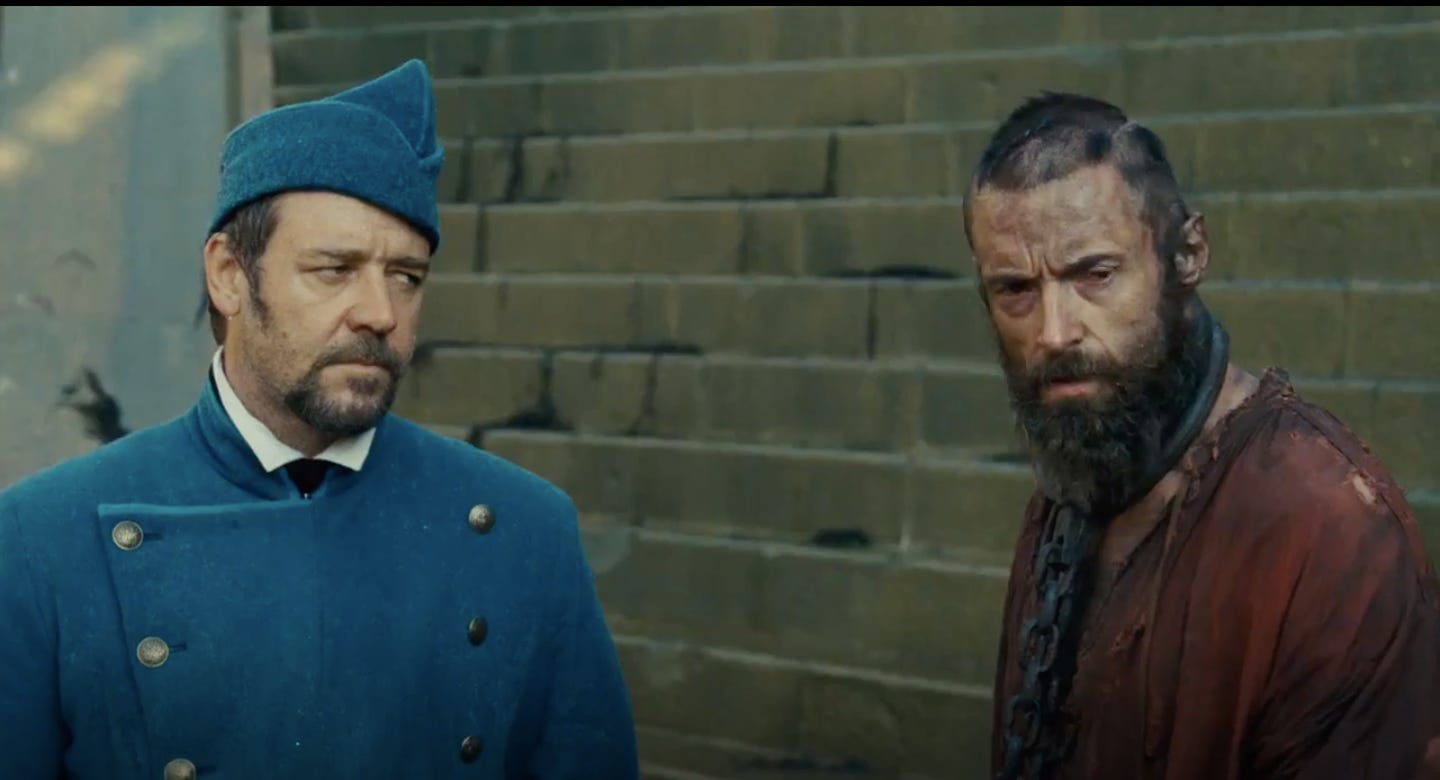
The musical Les Misérables opens with an interaction between our main protagonist, Jean Valjean, and antagonist, Javert. Jean Valjean is a prisoner in 19th-century France who receives parole after nineteen years of hard labor. We learn through his interaction with Javert — a prison guard — that he was sentenced to 5 years of prison for stealing a loaf of bread for his starving family. The remaining 14 years were tacked on for trying to escape before his sentence was up. Javert tells Valjean that he will be on parole for the rest of his life — effectively preventing him from making a living in post-revolutionary France.
After a period of homelessness and starvation, a bishop offers him food and a place to sleep. Despite this act of grace, Valjean loads up a knapsack of silver from the bishop’s home and takes off in the middle of the night. He doesn’t get far because, before daylight, the French police drop him back off to face the bishop. His only defense is the lie that the bishop gave him the silver. At this moment, his entire life is in the bishop’s hands.
Valjean doesn’t profess his faith in the bishop. He doesn’t repent. He doesn’t ask for forgiveness. The only thing he is able to do is hang his head and await his punishment. That’s when the bishop tells the officer that he had given the silver to Valjean as a gift. Before Valjean can process the grace that the bishop has extended to him, the bishop grabs his knapsack and begins filling it with even more silver as he sings:
But my friend, you left so early
Surely something slipped your mind
You forgot I gave these also
Would you leave the best behind
The bishop assures the policemen that he had indeed given Valjean the silver and tells them to release him. After they depart, he leaves Valjean with these words:
But remember this, my brother
See in this some higher plan
You must use this precious silver
To become an honest manBy the witness of the martyr
By the passion and the blood
God has raised you out of darkness
I have saved your soul for God
In the film adaptation, the immediate next scene shows Jean Valjean on his knees, praying to God. He is not praying a song of thanksgiving for the kindness, though; he is being torn apart by grief and shame. The first words he sings — What have I done? Sweet Jesus, what have I done? — are cracks that begin to reveal the true Valjean, living somewhere underneath the two decades of slave labor and degradation.
He continues, wrestling back and forth, trying to reconcile the reality he has known for twenty years — where you scratch and claw to survive, only looking out for yourself — with the grace the bishop has just offered him. He sings:
One word from him and I’d be back
Beneath the lash, upon the rack
Instead, he offers me my freedom
I feel my shame inside me, like a knife
This is the pivotal moment in Jean Valjean’s life. Not when he made the decision to steal bread to feed his starving nephew. Not when he was arrested. Not when he was released.
In this moment, he is offered grace, and he has to decide what to do with it. Ultimately, he decides to accept the grace that has been offered to him. He follows the bishop’s benediction and uses the silver to start a new life as a businessman and, eventually, becomes mayor of a small town.
It’s in that town, years later, where he is reintroduced to Javert.
Javert is no longer a prison guard but is now an inspector for the French police. Through several interactions, we learn that Javert is intensely committed to what he believes is justice and has incredible disdain for criminals and rebels. He is the perfect encapsulation of someone who rigidly believes in law and order.
When his paths cross with Valjean — now known simply as Monsieur le Maire —he begins to suspect that this is the prisoner who broke parole all those years ago. A man of principle, Javert makes a report of his suspicions. Conveniently for Jean Valjean, at the same time, the French police have arrested a man who looks just like him, believing that this is the true Valjean. Once Javert learns that this man has been arrested, he immediately comes to Monsieur le Maire (aka Valjean) to confess his error.
Javert is so principled and so committed to his concept of right and wrong that he urges Monsieur le Maire to press charges against him for the false report1. It seems like another win for Jean Valjean. All he has to do is allow this man to take his place, and he’ll be free of the stress of potential capture. To top it off, he could also press charges against Javert and get rid of the only man who could connect him to his past.
But Jean Valjean has received grace.
Not only does he tell Javert he won’t press charges, but he also decides to step in and save the innocent man who is mistaken for him. In the song Who Am I he wrestles with this decision:
Must I lie?
How can I ever face my fellow men?
How can I ever face myself again?
My soul belongs to God, I know
I made that bargain long ago
Jean Valjean has received grace, so despite the consequences, he is compelled to share that grace with others. He takes a dramatic carriage ride to the courthouse to reveal that he is the true Jean Valjean, letting the falsely accused man go free.
Valjean then has to go on the run and — starting with the sickest song ever — begins a nearly two-decade-long cat and mouse game where he is constantly trying to avoid being hunted down by Javert.
Javert embodies many of the traits that American Christians consider admirable. He is fiercely committed to law and order, is tough on crime, and believes in justice above all else. Javert has dedicated his life to ensuring that people who have broken the law face the appropriate punishment. He equates his mission and his values with those of God. This can be seen in his song, Stars, where he commits to doing whatever it takes to bring Jean Valjean to justice:
He knows his way in the dark
Mine is the way of the Lord
Those who follow the path of the righteous
Shall have their reward
He knows his way in the dark? The man whose crime was stealing a loaf of bread to feed a starving child?
Unfortunately, in Javert’s worldview, this is no different than any other crime. I wonder if there are any parallels with the “tough on crime” crowd of today? What are we — in the name of law and order — willing to allow to happen to people who are desperately trying to provide for their families? But I digress…
It’s fascinating to me that both Javert and Valjean are doing what they believe is God-honoring but have completely different goals and motivations. They both believe in justice but seem to have completely different definitions of what that word means. Javert’s view of justice is penal and focused on retribution. He is fully committed to this view of justice but lacks mercy. Valjean, on the other hand, received mercy from the bishop and continues to offer mercy to other people.
This very concept disgusts Javert. The idea that a criminal who has broken his parole and is living on the run could be capable of mercy — could be capable of anything not wholly self-serving — is completely incompatible with his worldview. To him, anything that Valjean does that resembles justice or mercy is just a thin veil covering his own desires. So he continues to hunt him with this promise:
Lord, let me find him
So I may see him safe behind bars
I will never rest ‘til then
This I swear
This I swear by the stars
The years go by, and Valjean manages to construct a life for himself and his adopted daughter, Cosette. If you’ve seen the show or the movie, you know I’m fast-forwarding through a lot of plot here. If you haven’t, go watch it. It’s worth your time. Cosette falls in love with a young man named Marius, who is part of a group of rebels who are trying to overthrow the French monarchy.
Javert finds himself infiltrating the very same rebellion, trying to bring it down from the inside. Unfortunately for him, the young group of rebels quickly discover that he is an inspector for the French police and tie him up behind their barricade.
Valjean goes behind the barricade as well in order to find Marius and protect him from the coming bloodshed. When he arrives, he learns that Javert is being held captive there, and the rebels hand Javert over to him.
Valjean enters the room where Javert — his antagonist from the very beginning — is tied up, and for the second time, he is holding all of the cards. He could kill Javert there, rescue Marius from the rebellion, and live out the rest of his life in peace. When Valjean pulls out a knife, Javert sees the writing on the wall and knows what is coming for him, singing:
You’ve hungered for this all your life
Take your revenge
How right you should kill with a knife
But Valjean doesn’t take his revenge. He cuts the ropes that are binding Javert and tells him to go free. Even then, Javert can’t accept that a criminal like Valjean could offer unconditional mercy like this. He assumes that Valjean must have ulterior motives and is looking for some sort of deal — which, of course, is something that Javert would not be able to accept, telling Valjean to shoot him because he would rather die than bargain with a thief.
Valjean, of course, doesn’t do this. He has received grace, so he extends grace to others. He tells Javert that there are no conditions and commends him for doing his duty. He even tells Javert where he can be found if they both survive the rebellion. Eventually, Javert accepts that there are no conditions to his release and escapes, leaving Valjean to focus on setting Marius free.
Valjean finally finds Marius and uses the (disgusting) French sewer system to pull him out of the rebellion and bring him home2. As he is literally carrying Marius on his back, Javert appears again, wasting no time to bring Valjean back to justice. Valjean petitions him that Marius has done nothing wrong and deserves to be taken to safety, ensuring Javert that he will turn himself in as soon as Marius is safe.
Javert scoffs at the notion, saying, The man of mercy comes again? And talks of justice?!, but — despite everything we’ve learned about him up to this point — he allows Valjean to go.
Letting Valjean go is completely contradictory to everything we’ve learned about Javert at this point. Earlier in the show a very similar moment happens, Valjean tries to help someone, Javert confronts him, Valjean petitions for the innocent person, and Javert shows no compassion whatsoever.
Now, Javert is allowing Valjean to walk right past him and, for a moment, it seems like Javert is experiencing some sort of growth. The very same melody that played when Valjean was offered grace by the bishop begins to play. This is a clue to the audience that this is now the pivotal moment in Javert’s life. Just like Valjean, he has been shown grace, and he has to decide what to do with it. He begins feverishly singing:
Who is this man?
What sort of devil is he
To have me caught in a trap
And choose to let me go free?
Being killed by Valjean would have confirmed all of Javert’s core beliefs. Once a criminal, always a criminal. Men like Valjean will never change. But Valjean allows him to go free. Could this be the turning point for Javert?
Unfortunately, Javert is unable to grow. He is unable to allow the grace he has received to change the way that he views Valjean, so he continues spiraling:
Damned if I’ll live in the debt of a thief
Damned if I’ll yield at the end of the chase
I am the law, and the law is not mocked
I’ll spit his pity right back in his face
Javert is starting to crack. He cannot accept a world where Valjean is both guilty of his crimes and able to show mercy — that a criminal could somehow be redeemed. He is so zealous in his beliefs that receiving mercy from Valjean is intolerable.
Compare this to Valjean’s breaking point at the beginning of the show. Valjean was hopeless and despondent. He had tried to make a living as a parolee, but faced rejection and suspicion everywhere he turned. He had become, as he puts it, a thief in the night and a dog on the run, but when the bishop offered him grace, he accepted it. And in accepting that grace, he committed his life to God.
Javert, on the other hand, has always had noble and righteous intentions. He believes that duty is divinely commissioned, and anyone who opposes him must also oppose God himself. Valjean letting him go when he had nothing to gain from it has shattered his worldview so much that it’s literally tearing him apart.
This is indeed the pivotal moment in Javert’s life. Accepting the salvation that Valjean offered him would mean accepting that Valjean is more than just a criminal. But doing that would also mean dismantling the rigid, black and white world he believed in. Ultimately, Javert comes to the conclusion that he cannot reconcile the reality that he had known with the one Valjean had offered to him. So he looks to the sky and sings:
I am reaching, but I fall
And the stars are black and cold
As I stare into the void
Of a world that cannot hold
I’ll escape now from that world
From the world of Jean Valjean
There is nowhere I can turn
There is no way to go on3
With those words, he jumps into the river Seine, ending his own life.
It would be appropriate at this point to ask what on earth all of this has to do with heaven and hell. In my last post, I shared that I think hell is real, but the hell I was referring to is some sort of after-death punishment. I also believe that there can be hell on Earth and that we can create that hell for ourselves.
A book that I read early on in my remodeling journey was Sinners In the Hands of a Loving God by Brian Zahnd. The sixth chapter is titled Hell… and How to Get There4. Zahnd would describe hell not as a place where the unrighteous go to be punished by God, but a place that the soul creates for itself when it is unable to accept the love of God. He puts it this way:
It has something to do with a wrong reaction to the very essence of God: love. We might even say that hell is the love of God wrongly received. Hell is not God’s hatred of sinners […] rather, hell has something to do with refusing to receive and be transformed by the love of God.
I have seen this firsthand, and I imagine that some readers may have as well. The refusal to accept into one’s soul the love of God or the love of neighbor. I can get behind the idea that brings about some sort of hell on Earth.
This brings me back to our friends, Jean Valjean and Javert.
Both men are offered salvation. Jean Valjean is offered salvation by a humble bishop who — without counting the cost — offers him a second chance at life. Javert is offered salvation by Jean Valjean, who — despite all preconceived notions — allows him to go away unharmed without any conditions.
Valjean accepts the grace offered to him by the bishop, turns his life around, and is able to live with the love of God and the love of neighbor, positively impacting every life we see him touch.
Javert is unable to accept the grace offered to him by Valjean and does everything in his power to try to reconcile what that means for him. In that process, he sings:
I should have perished by his hand
It was his right
It was my right to die as well
Instead, I live, but live in hell
Javert unknowingly crafted a hell on earth for himself. One where he cannot accept the love of God — that is full of both justice and mercy — and one where he certainly cannot accept the love from his neighbor, Jean Valjean. He determines that it is better to die than be tortured by this hell.
I think many Christians might be closer to this than we realize.
Now, I don’t think we are all going to jump into the nearest river (for me, that would be the Ohio, which would be a disgusting way to go).
But it’s worth noting that the character that we see experiencing this “hell on earth” is the one who wholeheartedly believes that he is working on behalf of God. Javert believes that what he is doing is righteous, and it’s a lot harder to accept the love of God when you think you’re already living under it. Alternatively, Valjean was able to accept God’s love because he fully looked at himself in the mirror and recognized he needed it.
There’s a reason that prostitutes, tax collectors, and other “notorious sinners” were drawn to Jesus, but the religious leaders viewed him as their opposition. They, like Javert, had built a delicate house of cards, and they weren’t about to let this Jesus fella mess with it.
For my part, I have seen many people build a house of cards and call it God. I fear what may happen when those houses start to topple.
One of the main truths that Javert built his house on was that there is a clear delineation between the righteous and the unrighteous. That once you crossed the Rubicon into the ‘unrighteous’ territory, there was no coming back. When Valjean pulled that card out, there was nothing preventing the whole house from coming down.
I wonder what those items are for us. What are the parts of our worldview that seem so true, but are actually keeping us away from the full love of God? Where are we, like Javert, unwaveringly clinging to an idea about who God is instead of allowing ourselves to be like Valjean and let God’s grace wash over and transform us?
Banks of the Euphrates will never use generative AI.
which, to be honest, seems like not a crime? but idk 19th-century France was a different place
This version of the song is very much worth listening to
Brian has graciously made that chapter free here on his Substack, so check it out.
I'm obsessed with this post. I'm not being hyperbolic when I say it's one of my favorite things I've read this year.
I've seen Les Mis live a handful of times (both "good" and "bad" productions), and each time I start crying at the Bishop's line, "You forgot I gave these also would you leave the best behind?" I'm usually still crying for bows.
On Parole/The Bishop is the movement where the Bishop saves Valjean. It starts with Valjean reminding himself never to forget the years and waste of prison. He says, "nor forgive them what they've done. They are the guilty, everyone."
And you know what, I agree. 19 years a slave to the law for stealing bread, when the oppression of France caused the starvation? In my book, he has every right to go scorched earth. That's what I'm usually ranting about when I find myself in a modern Valjean/Javert argument.
But Valjean receives a grace so big it even covers Javert, even though, in the end, Javert cannot accept it.
I also, at your behest, read Sinners in the Hands of a Loving God. I knew I didn't believe in "capital H, fire and brimstone" Hell, but I didn't know where to begin figuring out what I DID believe. I don't think Brian Zahnd had great answers, but he inspired great questions.
The one I keep coming back to - What do we get out of the hell we create? The ones for ourselves and the ones for other people? What does a century of believers gain from eternal conscious torment? Our understanding of empire demands oppression, and I think for some, "Jesus is on the throne" means somebody's in hell. For the oppressor, a validation of their worldview. For the oppressed, justice, finally, for those who were truly guilty, everyone.
Both Javert and Jean Valjean sing "I am reaching, but I fall." Me too, fellas. Me too.
Adam, your lucid writing reminds me of the unnamed female sinner (somewhere in Luke's gospel) who washed the feet of Jesus in the home of Simon the Pharisee. She was like Jean Valjean; Simon was like Javert. Maybe not totally - I get that - but enough to mention I think.